Posts

Back to the 70's - Mitre Cut Sails
Image
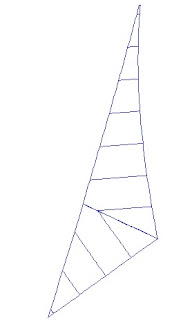
Back in the seventies it wasn't just all about  bushy hair and bad fashion. Actually it was! But in the sailmaking world, it was the realm of the mitre cut. When I began sailmaking in the late 70's at Brooke Sails, under the tutelage of Noel Brooke, every headsail we made was a mitre cut sail. The reason was pretty simple, the Dacron sailcloth we used was pretty crappy compared to todays woven cloths and Carbon was something that was left over on the grill after a BBQ! Sail Design was a lot harder back then as the Sail-maker had to think of not only shape but cloth stretch as well. The cloth was very spongy and stretched a lot, particularly in the warp direction along the roll and even more so on the bias. It was marginally more stable on the Fill or Weft direction. I can remember the late Ben Lexcen (or Bob Miller as he was then) telling me that they had to cut their 12 metre class mains 9" (230mm) short on the leech to allow for stretch as the mainsail was sheeted on....

In Praise of the International Cadet

Image
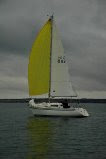
As I was finishing our most recent batch of cadet sails I began to muse on how we as sailmakers and myself personally have been involved in the Cadet class for many years as a sailmaker and more recently as a coach. Our cadet sails began over 25 years ago in a small tin shed on the waterfront, the sails were hand cut on a bench and assembled, one of our very early sets went on to win the Australian Championship that year. Our sails now are designed on the latest Smar Azure software ( the same software that was used in the design of the wing sail for Oracle in the Americas Cup) and computer cut for assembly by us. These sails have been constantly evolving and had much success at World, National, State and Regional level. After a break from the hands on role with the cadets whilst I did some big boat sailing. I decided to help out with the coaching at Royal Geelong Yacht Club ( mainly to avoid getting press ganged to one the various committees, it must be said).  This has led to ...

Pacific Spinnakers-RH Cruise Spinnakers

Image
I have found a lot of cruising yachties are often looking for a cruise spinnaker with-out breaking the budget. We have come up with a viable option. The Pacific range is a line of economical asymmetric or symmetric spinnakers aimed at the cruiser who wants a bit of extra horsepower when the breeze goes aft without breaking the bank. Floor-cut in the old fashioned way using skills honed from over 30 years ago working for Brooke Sails. They are made from 1st grade Nylon Spinnaker cloth with a Radial Head and Crosscut bottom panels. These sails provide a realistic option to second hand sails. For larger boats or more performance orientated roles we recommend a full radial panel layout.
Image
Looking forward to sailing Cinquante in the Sydney 38 Australian championships at the Festival of Sails in Geelong. The crew will be made up of junior and youth dinghy sailors with me taking it easy at back.

Spiinaker Drops Part 2

Image
Add caption Last edition we spoke about the need to have a default program to dropping our spinnaker. Develop this and practise it.  As the competence level increases so does our ability to incorporate more complicated manoeuvres into our spinnaker dropping techniques. The first variation is the Port side windward drop discoursed last time which enhances the boats tactical options and reduces the need for a lot of the spinnaker packing/ tidying up around the boat. It is really refreshing as part of an afterguard to have a crew that can respond quickly to a simple call from the back when approaching the mark. If they can respond to a change of mind at the last minute it is even better. Regular enthusiastic crew and practise is needed to reach this level. So let’s have a look at a few more variations The Kiwi Drop Mostly used on asymmetric spinnaker boats. Called a Mexican drop in the northern hemisphere, it is a procedure where the spinnaker is dropped as the boat is gy...
Image
Losing the kite A lot can go wrong on the race track and retrieving the spinnaker is one area that is fraught with danger and too often goes wrong. A successful drop relies on a few key points. It is a drill that involves multiple crewmembers all working in synchronisation. They must all be able to do their roles in the right sequence. So allow a lot of time for each to do their job. One of the bigger issues these days is to find regular crew and this can be a real problem for a lot of racing boats. If you have a chopping and changing of the guard on a regular basis then it is important to have a default setting for your spinnaker work. This would entail a tried and true retrieval system that is fairly safe. A familiar dousing technique enables you to incorporate a few newbies into their roles with a minimum of fuss. Be precise with your instructions of when and where they need to be and what they need to do and look out for them. You can work all this out doing very conservativ...

Current Affairs

Image
The rise and fall of the sea is one of those phenomena that occur as a constant. The waxing and waning of the moon have always had a bearing on our lives. This pattern repeats itself at incredibly regular intervals and as we know it waits for no man. King Canute once famously tried to order the tide to stay back to prove his supremacy which was a spectacular failure. But in fairness to old Canute it must be said it was probably to prove the folly of human self-significance to others. Tide has always played a role in waterborne transport harking back to the birth of civilization in the Nile delta.  One thing we know is that seafarers who used the tide to their advantage in war or commerce have always had a healthy edge over their rivals. This is also the case with yacht racing; there are those who embrace it and succeed and those who are intimidated by it and fail. Knowledge- We needs to understand how the tide works on a certain area in order to be able to utilise it. The a...